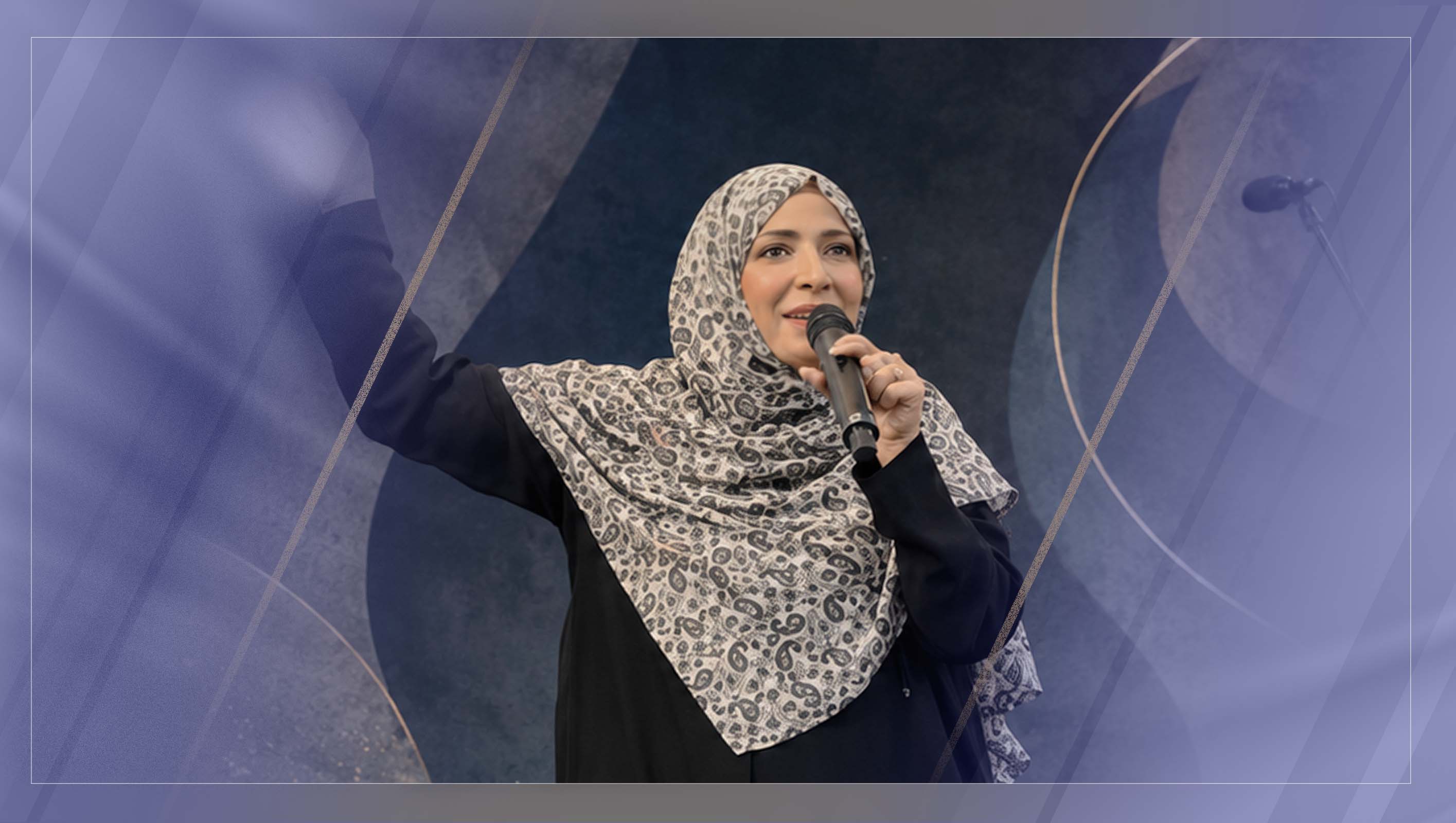
Baden, Switzerland — Human rights advocate and Nobel Peace Prize laureate Tawakkol Karman spoke on Saturday at the Disputation Festival marking the 500th anniversary of the Baden Disputation, where she addressed the importance of dialogue, justice, freedom, and peaceful resistance in confronting contemporary conflicts and authoritarianism.
Speaking before an international audience in Baden, Karman reflected on the enduring relevance of dialogue in a world still grappling with war, political divisions, and human rights challenges. She noted that five centuries after the historic Baden Disputation, humanity continues to face the same fundamental question: whether differences can be resolved through dialogue rather than violence.
"The fundamental question remains the same: Can we live peacefully with our differences? Can we choose dialogue over violence?" Karman said.
Referring to conflicts in Yemen, Gaza, Sudan, Iran, Ukraine, and other regions, she argued that many of today's crises extend beyond military and political confrontations and reflect deeper challenges related to justice, accountability, and human rights.
Karman described hope as an essential element of peaceful resistance, emphasizing that authoritarian systems seek to undermine belief in the possibility of change.
"True hope is an act of resistance," she said. "Tyrants and wars always seek to extinguish hope first, for they know that when a person loses faith in the possibility of change, surrender becomes easier."
She also stressed that lasting peace cannot be achieved in the absence of justice.
"True peace is not simply the quieting of guns, but the presence of justice," Karman said. "Peace built on injustice cannot endure, for it is not peace at all."
Addressing the role of technology, Karman warned against its use for surveillance, disinformation, and restrictions on freedom of expression, while emphasizing its potential to expand access to information and strengthen civic engagement.
"The battle is not only fought on the ground, but also for awareness, for truth, and for the freedom of human thought and expression," she said.
Karman highlighted the role of younger generations in addressing global challenges and called for new approaches capable of responding to the realities of the present era.
"The world cannot be saved by the same old mindsets that helped create its crises," she said. "It needs a new generation with the courage to dream differently, think differently, and build a different future."
Concluding her remarks, Karman expressed solidarity with activists and human rights defenders around the world who continue their efforts in pursuit of freedom, justice, and human dignity.
"Freedom may be delayed, but it never dies," she said. "Darkness may seem long, but history does not belong to the strongest — it belongs to those who continue to struggle for dignity, justice, and humanity."
The Disputation Festival continues through the weekend with discussions and cultural events focused on intercultural dialogue, democratic participation, and the future of peaceful coexistence.
Here is full speech
Ladies and Gentlemen,
Dear Friends,
It is both a pleasure and a profound honor to stand here today in Switzerland, in the city of Baden — a city that carries within its memory one of the most emblematic chapters in the history of human dialogue: the Baden Disputation, held five centuries ago, when people of different faiths and convictions chose words over weapons, and listening over hatred.
Perhaps this is what makes our gathering today all the more significant. For five hundred years later, the world still confronts the same fundamental question: Can we live peacefully with our differences? Can we choose dialogue over violence? And are we, as humanity, still capable of safeguarding our own humanity amid such devastation?
We find ourselves in turbulent times — an age of open wars, deep polarization, rising hatred, eroding democracy, and a widening gulf between the values proclaimed and the realities endured by millions. From Yemen to Gaza, from Sudan to Iran, from Ukraine to countless other places, we witness not only political and military conflicts, but a profound crisis of human conscience itself.
We see children buried beneath rubble, cities reduced to ruins, people driven from their homes, and voices silenced — while the world stands at times helpless, at times complicit, and too often absorbed in calculations of self‑interest rather than the value of human life.
Amidst all this, a legitimate question arises: Is there still room for hope?
And my answer is: Yes.
But the hope I speak of is neither naïve optimism nor an escape from reality. True hope is an act of resistance. To hold fast to your humanity in the face of cruelty is resistance. To defend freedom despite fear is resistance. To reject hatred even when the world pushes you toward it is resistance.
Tyrants and wars always seek to extinguish hope first, for they know that when a person loses faith in the possibility of change, surrender becomes easier. To preserve hope, therefore, is not a luxury — it is a moral and human imperative.
Yet we must also ask ourselves: What does the peace we long for truly mean? Is peace merely the absence of war? Is it silence enforced by fear and oppression? Can we call it peace while people are denied freedom, dignity, and justice?
True peace is not simply the quieting of guns, but the presence of justice. There can be no lasting peace while human rights are trampled, while peoples are occupied, while voices are imprisoned for their opinions, or while some lives are deemed less valuable than others.
Peace built on injustice cannot endure, for it is not peace at all — only a fragile truce laid over an open wound.
And in the fearful world we inhabit today, courage itself becomes an extraordinary act. But courage is not the absence of fear; it is the resolve to overcome it.
All peaceful revolutions and liberation movements have begun with ordinary people who decided that their dignity outweighed their fear. Young people who stood with bare chests before bullets. Women who endured imprisonment, torture, and threats because they refused to be silenced. Journalists, activists, mothers, fathers, and countless ordinary citizens who chose to say ‘no’ at a time when silence seemed safer.
This is what authoritarian regimes truly fear: the free human being. Tyrants fear not only weapons, but also words, awareness, and collective memory. For peoples who remember their dreams do not die — even if they stumble, even if they are temporarily defeated.
Yet today our world faces not only the perils of traditional warfare, but also the dangers of technology when it shifts from a tool of liberation to a tool of oppression. Once, technology helped dismantle walls of fear and carried truth to the world. But authoritarian regimes quickly learned to weaponize it for surveillance, disinformation, and control. With the rise of artificial intelligence, cyber warfare, and algorithms that shape what we see and think, a chilling question emerges: Is truth still possible in the age of digital manipulation?
The battle, therefore, is not only fought on the ground, but also for awareness, for truth, and for the freedom of human thought and expression. And in the face of all this, I remain convinced: peaceful resistance is both necessary and possible.
It may not be the easiest path, but it is the path that preserves our humanity as we struggle for freedom. For the goal is not merely to overthrow injustice, but to build a world that does not reproduce it.
Perhaps one of the most vital lessons for our time is that dialogue is not weakness, but courage. In an age of populism, hatred, and racism, dialogue itself becomes an act of resistance against division. The world need not be homogeneous to live in peace; it must learn to respect its differences.
Difference can be a cause of war, but it can also be a source of strength, creativity, and progress. Great civilizations were never built in isolation, but through the interaction of cultures, ideas, and peoples.
Thus, dialogue among religions, cultures, and nations is not an intellectual luxury, but a necessity for humanity’s survival.
Yet the deeper question before us is: What does it mean to remain human? How do we preserve empathy in a world numbed by images of death? How do we protect dignity in an age of cruelty? How do we prevent hatred from consuming us?
The greatest danger is not only war, but the erosion of humanity’s ability to see one another as human beings. Compassion, therefore, is not weakness, but immense moral strength. And the responsibility for protecting humanity rests not only with governments, but with each of us — in our words, our actions, in how we raise our children, and in our defense of truth and justice.
I believe that the greatest hope today lies in young people. The world cannot be saved by the same old mindsets that helped create its crises. It needs a new generation with the courage to dream differently, think differently, and build a different future.
Yet the real challenge is not only to protest, but to create alternatives — to transform pain into a project of change, to move from resisting reality to building a more just and humane future.
Despite all that is happening, I still believe in humanity. I believe because I have seen peoples rise from the rubble, young people face bullets armed only with dreams, mothers raise children on love amidst war, doctors save lives under bombardment, and ordinary people refuse to surrender their humanity even in the darkest of times.
My message today to those who resist everywhere is this: Do not let despair defeat you. Freedom may be delayed, but it never dies. Darkness may seem long, but history does not belong to the strongest — it belongs to those who continue to struggle for dignity, justice, and humanity.
What the world needs is not more domination, but more justice.
What the world needs is not more fear, but moral courage — the kind that restores the value of human life.
And perhaps this is the true meaning of hope: to go on defending humanity, even when the world feels less peaceful, less secure, less just, and less fair.
Because the future will always belong to those who refuse to give up.
Thank you.