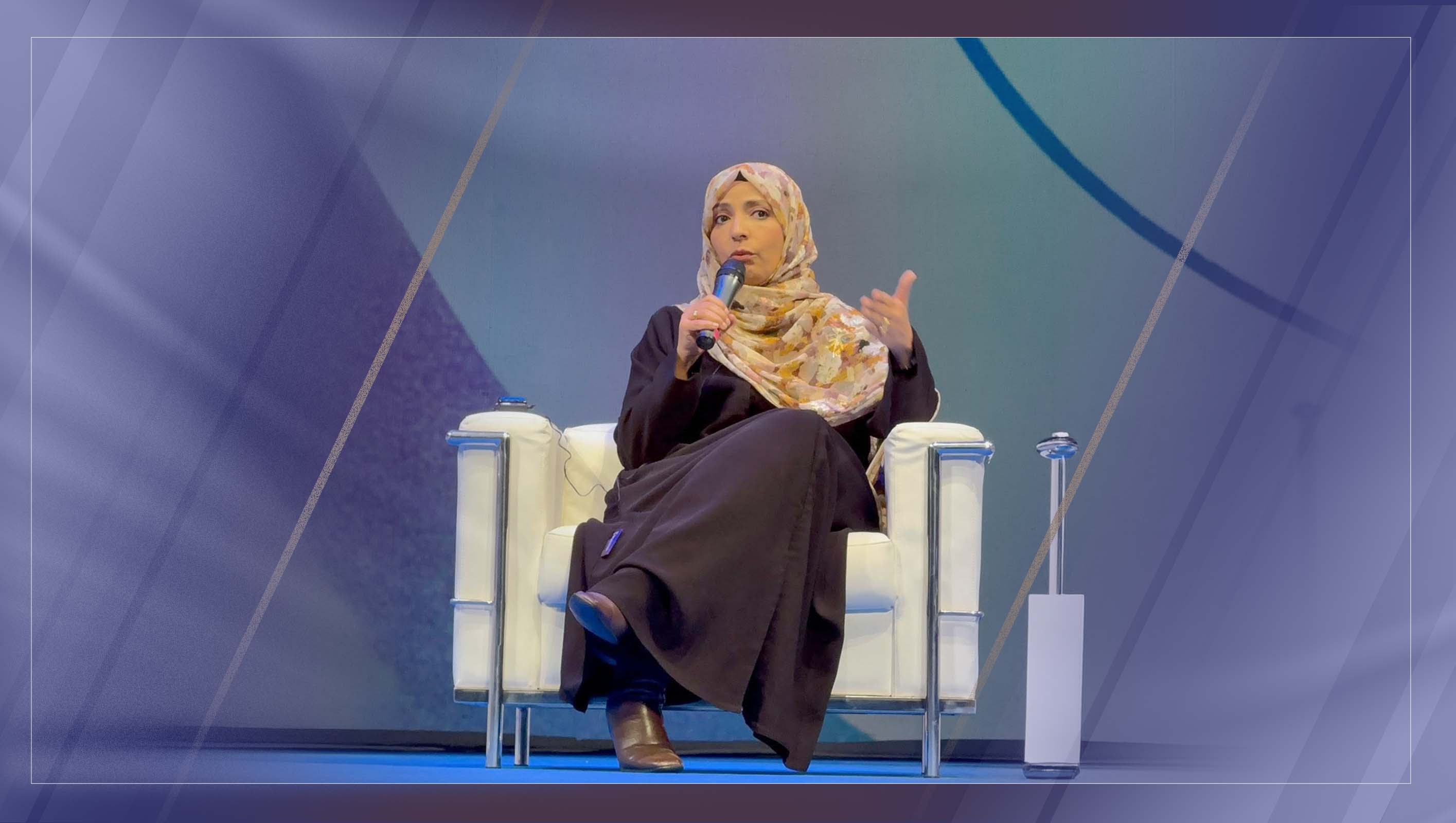
ZARAGOZA, Spain — Speaking at the prominent international conference “The World To Come,” Nobel Peace Prize laureate and human rights advocate Tawakkol Karman delivered a forceful indictment of the fractured international order, charting a path forward through an urgent appeal for a new generation of global leadership.
Throughout her address, Karman cautioned that emerging societies and developing nations face an existential threat striking at the very heart of their democratic processes and sovereign stability. She described the current wave of democratic backsliding, together with the alarming spread of hate speech and xenophobia, not as isolated phenomena but as the direct consequence of systemic failures by today’s leaders to honor their commitments to sustainable development — particularly their unfulfilled promises of a viable future for younger generations.
Confronting Selective Justice and Global Double Standards
To underscore the gravity of the crisis, Karman pointed to violent and extremist rhetoric deployed by certain prominent leaders. She specifically cited the destabilizing discourse of U.S. President Donald Trump as symptomatic of deep structural imbalances within the international system.
In her analysis, the modern era remains dangerously defined by institutional hypocrisy. As a stark example of global inaction, she highlighted the occupied Palestinian territories, where Palestinians endure daily oppression under Israeli occupation without meaningful intervention from the international community. She drew sharp parallels between this ongoing occupation and the impunity enjoyed by authoritarian regimes worldwide, which repress their citizens while democratic states largely remain silent.
Karman stressed that democratic nations must urgently unite to dismantle the corrosive doctrine of “double standards” that paralyzes international law. She insisted that the global order must be reformed to fulfill its obligations to all peoples, rather than serving only a privileged few. She further criticized contemporary globalization, arguing that in its current form it functions primarily as an engine of inequality — enriching wealthy nations while systematically marginalizing poorer countries economically, politically, and socially.
A Vision for Transitional Leadership and Systemic Reform
To counter this trajectory, Karman called for a paradigm shift in global governance, urging a new generation of young leaders to step forward and rescue international systems from collapse. Pointing to sterile government policies incapable of self‑correction, she advocated for the creation of a fair, representative global governance structure equipped with binding mechanisms to compel state compliance in areas of sustainable development, transitional justice, peace, human rights, and environmental protection.
She warned that authoritarian forces will continue to expand and dominate if the world remains passive, adding that the suffering and injustice engineered by dictatorships will not remain confined to impoverished nations but will inevitably spill over, destabilizing democratic states and global powers alike.
Dismantling Hegemony and Expanding Civic Responsibility
True leadership in the modern era, Karman argued, requires the courage to confront hegemonic state powers, monopolistic corporations, and the unchecked influence of billionaires whose greed threatens the climate, economic stability, and humanity’s future. She stated that the first step toward transformation begins with young people preparing themselves for governance, rather than waiting for an entrenched political class that has proven incapable of saving the world from destructive excesses.
Karman emphasized that new leadership must not be confined to the halls of government. It must be cultivated across all arenas of civic life, including:
· NGOs and civil society
· Independent media and investigative journalism
· Political parties, parliaments, and private enterprises
Addressing the social responsibility of the private sector, she criticized wealthy nations for retreating from humanitarian commitments on poverty reduction, healthcare, and education. She cited the U.S. withdrawal from the Paris Climate Accord as a prime example, arguing that private companies now bear a moral and operational burden to fill the vacuum left by governments.
Karman insisted that corporations can no longer operate solely as profit‑driven entities. Instead, they must dedicate resources to stabilizing communities, combating poverty, ensuring equitable education, and safeguarding human rights.
She concluded with a universal call to action, affirming that the salvation of the global order depends on decentralized leadership across every tier of society. She urged individuals everywhere to awaken their inner agency, embrace their potential to lead, and actively drive the structural change the world so urgently requires.