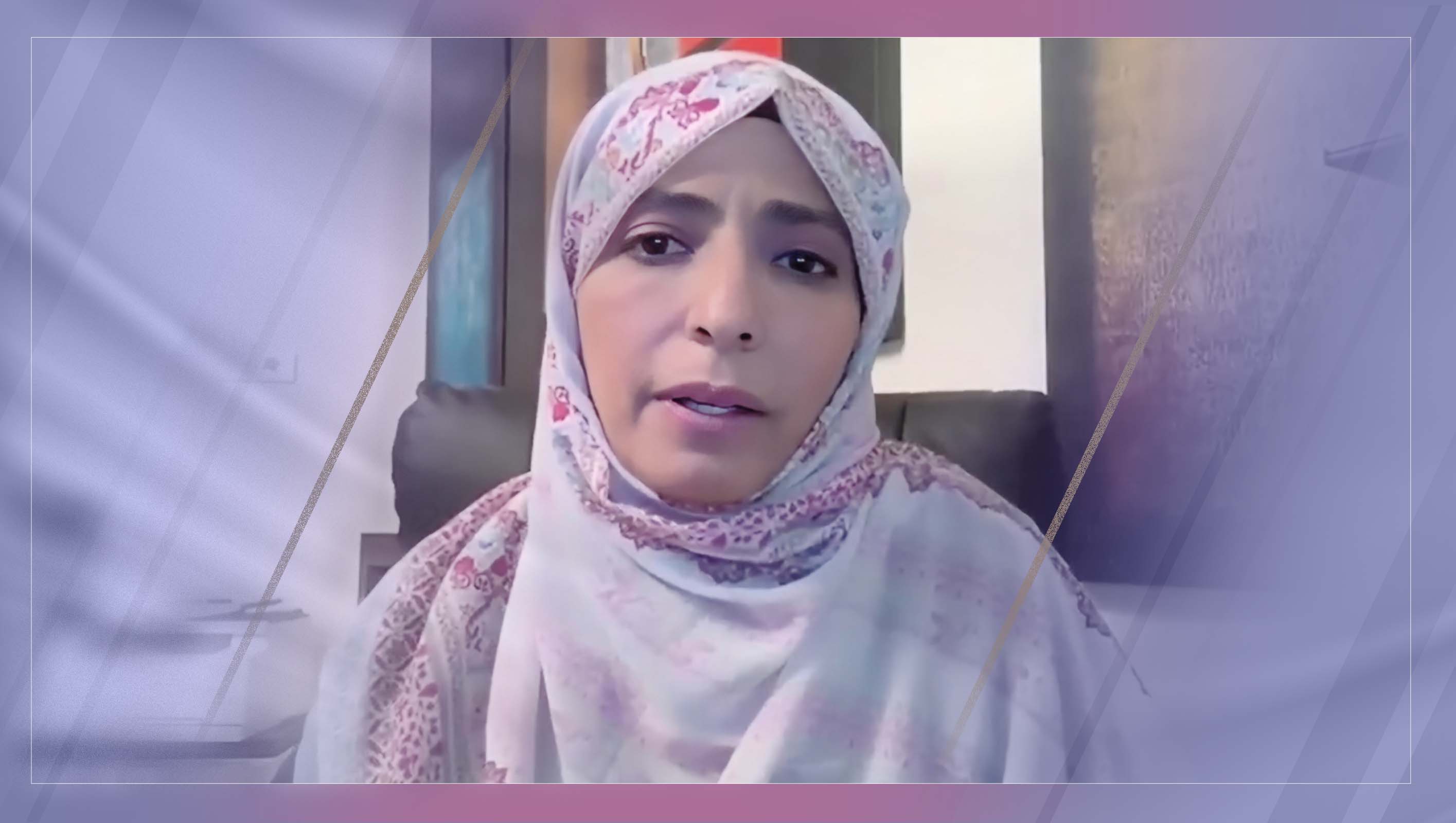
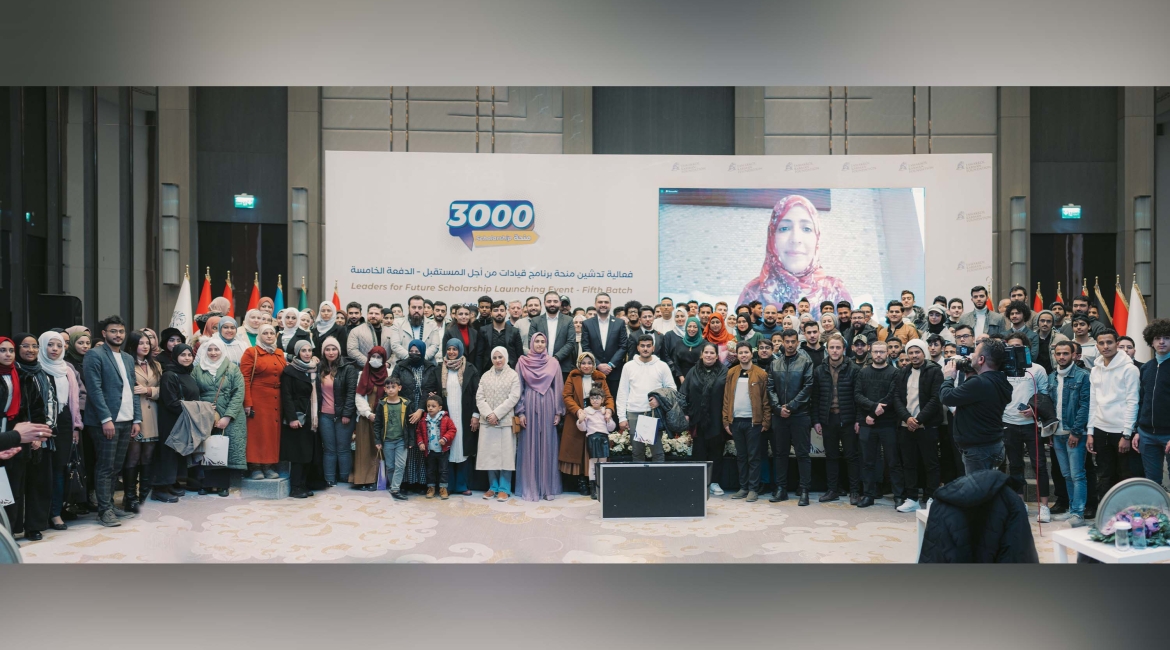
Human rights advocate and Nobel Peace Prize laureate Tawakkol Karman delivered a keynote address at a major Iranian opposition conference, reaffirming her support for the Iranian people’s struggle for freedom and democracy while warning against the dangers of external military escalation.
The conference, organized by the National Council of Resistance of Iran (NCRI) under the leadership of Maryam Rajavi, brought together international political figures, human rights advocates, and global leaders to spotlight ongoing human rights violations in Iran and to support the aspirations of its people for democratic governance.
In her remarks, Karman praised the resilience of the Iranian people, describing them as a nation that has “never ceased striving for freedom and dignity.” She expressed confidence in their ability to reclaim their rights and build a democratic state founded on equal citizenship, the rule of law, and respect for the people’s will.
Reflecting on Iran’s modern history, she cited the 1953 overthrow of Prime Minister Mohammad Mossadegh, backed by the United States and Britain, as a turning point that derailed Iran’s democratic path. She also pointed to the authoritarian rule of the Shah and the subsequent establishment of the Islamic Republic under Ayatollah Khomeini, noting that both eras were marked by repression and exclusion of popular will.
Karman emphasized that, despite decades of oppression and conflict, the Iranian people have never abandoned their demand for freedom. She highlighted waves of peaceful protest and the sacrifices of activists and prisoners of conscience, paying tribute to fellow Nobel laureate Narges Mohammadi and all those detained for their commitment to justice.
Reaffirming her position, Karman called for greater political, moral, and human rights support for movements working toward a free and inclusive Iran. At the same time, she strongly rejected ongoing military escalation involving the United States and Israel, cautioning that such intervention risks weakening Iranian society, fragmenting the country, and turning it into a battleground for geopolitical competition.
“The Iranian people alone have the right to determine their future,” she declared, underscoring that sustainable change cannot be imposed from outside.
She further warned that the consequences of war would extend beyond Iran, threatening civilians, infrastructure, and economic stability in the Gulf and Lebanon, while posing broader risks to international peace, global trade, and security.
In conclusion, Karman reiterated her dual stance: a firm rejection of authoritarianism in all its forms, alongside clear opposition to wars that fragment nations and undermine sovereignty. Her participation reflects her continued advocacy for democratic movements and her commitment to supporting peoples’ rights to freedom, dignity, and self determination across the region.
Here is the text of Tawakkol Karman’s speech at the Iranian opposition conference
Ladies and gentlemen,
Dear friends in the ranks of the Iranian opposition and resistance,
Peace be upon you.
First, I would like to thank my dear Maryam Rajavi for inviting me to this important conference. I greet you all, and through you, I salute the great Iranian people—those who have never ceased striving for freedom and dignity.
I have always believed that the Iranian people are a great nation, a nation alive in its conscience and history, a nation that has never stopped struggling to live free and dignified in a homeland governed by law, not tyranny.
And I firmly believe that this people is capable of reclaiming its freedom with its own hands, and capable of leading Iran toward a true democratic state built on equal citizenship, the rule of law, and respect for the will of the people.
Dear friends,
What the Iranian people suffer today—oppression, repression, wars, and struggles over power and wealth—is not a passing moment in the history of this great nation. It is the continuation of a long chain of historical mistakes and crimes committed by tyrants in Iran, compounded by foreign conspiracies and interventions led by the West.
One of the decisive turning points came in 1953, when the democratically elected government of Dr. Mohammad Mossadegh was overthrown in a coup supported by the United States and Britain, after he sought to restore his country’s sovereignty over its resources.
Following that coup, the Shah was reinstated with full Western backing, ruling Iran for many years with an iron fist—marked by widespread political and financial corruption and severe repression of freedoms.
Another turning point came when Ayatollah Khomeini was welcomed in France, and arrangements were made for his return to Iran in 1979 aboard an Air France flight. He then established a theocratic, authoritarian regime that usurped the will of the people and ruled the country with an iron fist.
Since then, Iran and the region have been trapped in a long cycle of wars, conflicts, and crises. This regime entrenched its power through domestic repression, while exporting its crises abroad by interfering in regional affairs.
Decades of international silence and political complicity followed, allowing this regime to consolidate its grip at home through oppression, and to spread turmoil abroad by fueling conflicts in several Arab capitals.
Yet, despite all of this, one truth remains clear: the Iranian people have never surrendered. Time and again, they have taken to the streets demanding freedom, confronting repression with their peaceful hands and bare chests. They have sacrificed thousands of martyrs and tens of thousands of prisoners—men and women alike—for the sake of their freedom, dignity, and future. This alone is proof that the spirit of liberty is still alive in Iran, and that the will for change has not, and will never, be broken.
And here, I extend a special salute to my fellow Nobel Peace Prize laureate, Narges Mohammadi, in her prison cell, and to all prisoners of conscience and freedom fighters in Iran.
My position on this issue has always been clear and unwavering: to stand with the revolution of the Iranian people and their resistance to overthrow the rule of the mullahs, and to call for every form of political, moral, and human rights support that can help them achieve this goal.
Because the Iranian people deserve freedom. They deserve democracy. They deserve an end to clerical tyranny. And because the peoples of the Arab region have long suffered from dictatorship, wars, and interventions—foremost among them Iranian interventions that have torn apart nations and weakened societies.
The tyrannical regime of the mullahs has not been content with oppressing its own people—an oppression that alone deserves a thousand revolutions—but has also fueled sectarianism, supported militias, and ignited wars in several countries of the region. Its destructive policies have extended to many Arab states, and my own country, Yemen, has borne a painful share of these interventions, which have supported militias, fueled coups and wars, prolonged conflict, and deepened the suffering of the Yemeni people.
Yet, despite all this, I must emphasize: while I support the right of the Iranian people to overthrow the mullahs’ regime, I strongly reject the American–Israeli war on Iran. I reject the bombings and destructive wars waged from outside under the false pretense of supporting peoples, when their true aim is to impose domination, expand influence, and plunder the wealth and political and economic sovereignty of nations.
The aim of the Israeli-American war on Iran is not to replace the despotic mullah regime with a democratic system in which the Iranian opposition and the Iranian people have the final say and a genuine, active role in Iran's freedom, development, governance, independence, and stability..
Its objective is not to support the freedom and democracy of the Iranian people. This war aims to destroy Iran, fragment its territory, weaken its society, and prevent the Iranian people and their revolution from achieving their historic victory over tyranny and building their free, democratic state.
What the United States and Israel seek from this war is to impose political arrangements that either preserve elements of the current regime—as seen in Venezuela—or recreate a system that the Iranian people have already rejected, namely the authoritarian rule of the Shah. In both scenarios, the outcome would be a dependent regime, subordinate to external influence, enabling control over the country’s resources—particularly oil, minerals, and its strategically significant geopolitical position.
On the contrary, such a war produces deeply dangerous consequences: it weakens Iranian society, undermines the opposition, and erodes the prospects for peaceful change, while turning Iran into a battleground for external influence and competition over wealth.
The Iranian people alone have the right to determine their future. They alone possess the capacity to end tyranny and build a free and sovereign state.
The destructive effects of this war extend far beyond Iran, reaching the wider region. This is already evident in the Gulf and in Lebanon, where missile strikes and the targeting of vital infrastructure—particularly oil facilities—place civilians and regional economies at serious risk.
The repercussions do not stop there. They threaten international peace and security, disrupt global trade, and deepen instability worldwide. For these reasons, this war does not advance the cause of freedom in Iran.
Let me conclude once again, and with clarity:
I reject and condemn the despotic regime of Iran’s mullahs—a regime that has oppressed the Iranian people on the one hand, and on the other has devastated our region by supporting militias, fueling sectarianism, waging wars, and destroying cities. I also condemn Iran’s attacks on the Gulf states, its violations of sovereignty, and its threats to regional stability, which bring nothing but greater suffering and destruction to our peoples.
We stand with the revolution of the Iranian people against tyranny—whether the tyranny of the mullahs, the tyranny of the Shah, or any other form of tyranny in Iran or across the region.
We stand with the right of Iranians to freedom and democracy. We stand with the opposition, the resistance, and the Iranian people.
But at the same time, we stand firmly against this destructive American–Israeli war on Iran, its people, and the entire region. We are against wars that seek to fragment nations, dominate them, and turn them into arenas of conflict for influence, while plundering the wealth and sovereignty of peoples.
Thank you!
To watch speech click here